


Jiangsu Province primary and secondary school teaching and research section experts Ye Bing to visit SWR to guide the work! Praise the TESS experimental box quality first-class concept advanced!
Release time:
Mar 19,2020
On March 17, 2020, Ye Bing, deputy director of the teaching research office of primary and secondary schools in Jiangsu Province, visited the company to inspect and guide the work at the invitation of SWR. Accompanied by General Manager Wang Zhifei of SWR, Director Ye watched the company's entire range of products: from sensors, experimental equipment to TESS experimental boxes, from experimental instruments to experimental resource management cloud platform and online experimental design platform, SWR showed and introduced them one by one.
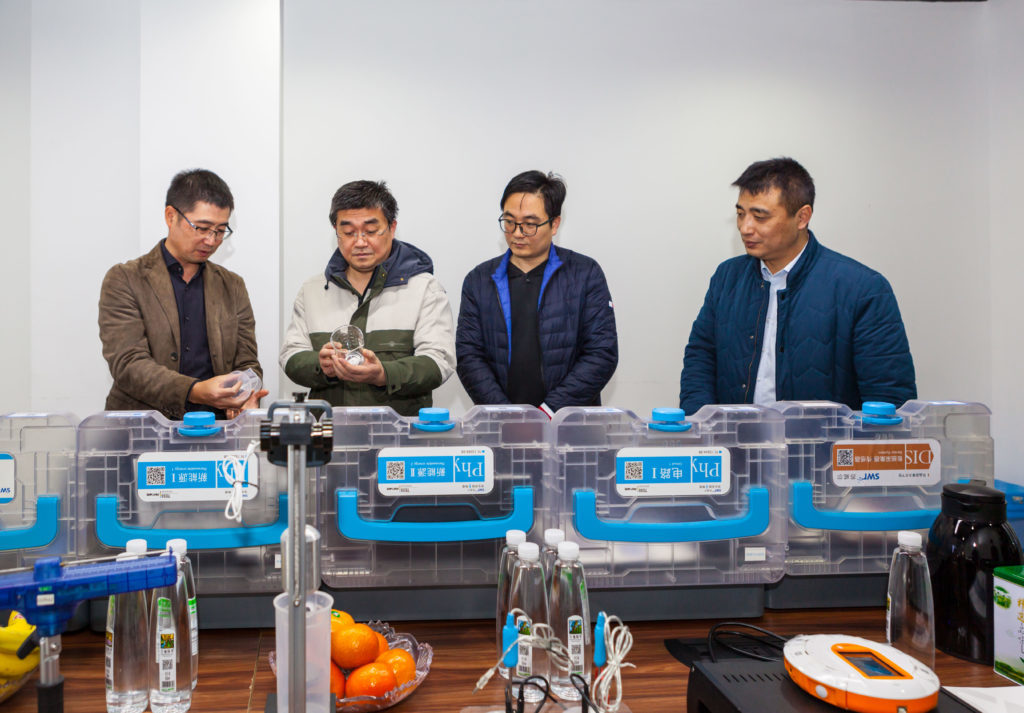
Director Ye expressed his full affirmation and appreciation to SWR, and hoped that the company can continue to maintain first-class product quality, work hard in the future education career, and achieve more outstanding results.
Director Ye carefully observed the Suwell experimental instrument and said: The quality of the experimental box is first-class and the concept is advanced!
At the meeting, Mr. Wang introduced in detail the background, product quality, development status and future direction of TESS experimental box. Li Wu of Suweir Application Center demonstrated the multifunctional use of TESS experimental box on the spot.

Seeing the TESS experimental box imported from Germany, Director Ye carefully observed it and said on the spot: "The quality and quality of the experimental box is first-class, there is no doubt about it! The concept of the experimental box is also very advanced, and the modular design adopted can complete a variety of innovative combinations, which requires a high level of hands-on ability for students."

Director Ye also gave great affirmation to the two cloud platforms (experimental resource management cloud platform and online experimental design platform) independently developed by SWR: "The experimental resource management cloud platform not only involves instrument management, but also provides a two-way connection between experimental courses and experimental instruments, providing big data and application analysis support for management decisions of schools and education departments."

In addition, SWR's digital photoelectric effect experimenters, digital mechanical energy conservation experimenters, buoyancy law experimenters, dynamic systems and other experimenters have also been appreciated by Director Ye.

SWR's digital photoelectric effect tester is based on the needs of front-line teaching, developed in cooperation with high school physics teachers in Changzhou No.1 Middle School, and has won many awards in domestic lecture competitions. The law of buoyancy adopts the "overflow method", which is highly consistent with the experimental method of teaching materials, and is loved by many teachers. Director Ye said: "This kind of experimental device that can solve traditional experimental problems is what front-line teachers urgently need."
Director Ye: The experimental device should really meet the experimental teaching needs of front-line teachers.
After the observation, Director Ye also had extensive and in-depth exchanges with SWR.

Director Ye put forward his own views on how to use the experimental device to solve the important and difficult problems in teaching:
Grouping experiments, demonstration experiments and expanding experiments should be treated differently to truly meet the experimental teaching needs of front-line teachers.

In addition, in teaching, experimental equipment should help students understand subject knowledge and laws, and visually present experimental phenomena. This requires experimental equipment not only to retain the essence of traditional experiments, but also to profoundly show subject ideas, and to combine with digitization to accurately and intuitively display data.
For example, in traditional experiments, a doting timer is used to measure acceleration, while the doting timer is an experimenter containing physical ideas. During the experiment, students can reflect time through the spatial changes of doting. It is difficult to verify the law of electromagnetic induction quantitatively in traditional experiments. The "sound wave" is not visible, but the sound wave can be "displayed" in an intuitive image through sensor technology.
Therefore, only by combining the ideas in traditional experiments with digitalization and using digital technology to visually present the experimental phenomena can we solve the problems encountered in traditional experiments and truly become popular products.

7F, No.1 Building, Tianan Cyber Park, No.36 Yongfeng Road, Qinhuai District, Nanjing, China. (R&D centre)
No.306 Wenchang Road, Yongyang Street, Lishui Disctric, Nanjing, China. (Manufacturing base)

©COPYRIGHT 2023 Jiangsu SWR Science & Technology Co.,Ltd. ALL RIGHTS RESERVED | SEO